Hinweis: Einige Seiten auf astro.uni-tuebingen.de können veraltet
sein und werden nicht mehr aktualisiert. Note: Some webpages at astro.uni-tuebingen.de may be outdated and
will no longer be updated.
Integration time: 2989 s (sum of 2 measurements)
Count rate: 77 c/s
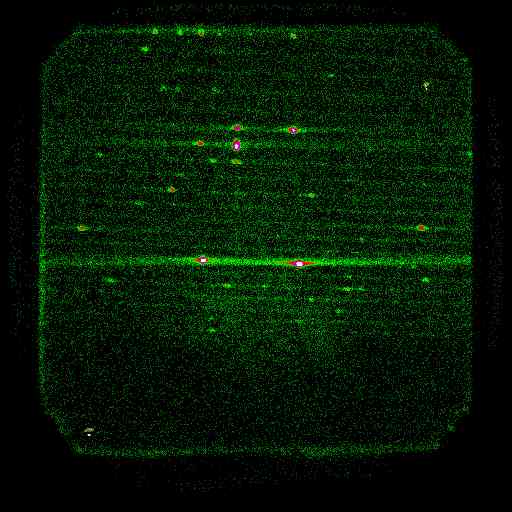
Echelle image of the spectrum of RR Tel, a symbiotic double star system.
In this typical emission line spectrum several bright spots are to
be seen. Each of them represents a single spectral line emitted from
this double star system. The horizontal bright strip in the center of
the image is produced by stray light from both of the two very bright
oxygen emission lines (O VI) at 1032 Å and 1037 Å,
produced by the Echelle grating. The straylight strip runs exactly horizontal
across the image, while the individual spectral orders are slightly tilted.
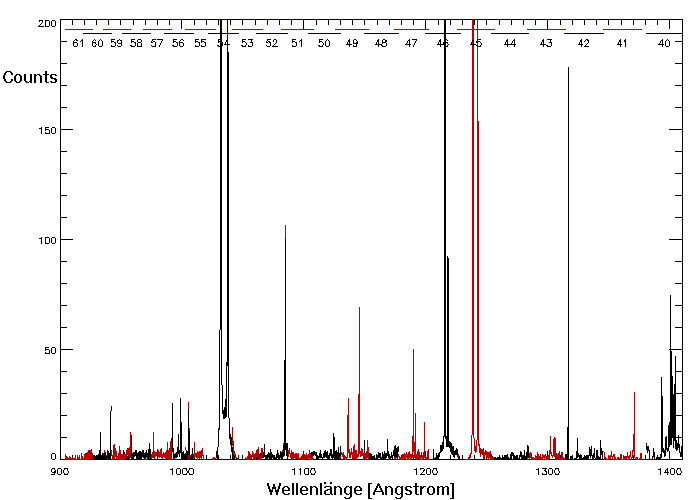
This is the spectrum ectracted from the image shown above. Shown is the
brightness (number of photons per spectral pixel) against the
wavelength (in Angstrom, Å). It is clearly seen, that the spectrum
nearly solely consists of numerous sharp emission lines.
Example 2: HD 49798
Integration time: 1292 s
Count rate: 6200 c/s
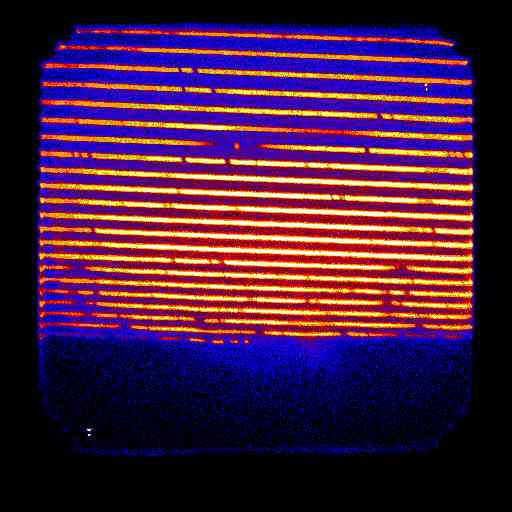
In contrast to the image of RR Tel this image of the Echelle spectrum
of the hot star HD 49798 shows the individual spectral orders as bright strips,
which are interrupted by several dark narrow regions.
These dark regions are absorption lines, which are mainly produced by
interstellar matter, located between the star and us, which absorbes
the light from the star on its way to the observer.
Each atom or ion absorbes light of a characteristic wavelength, thus
allowing to determine the chemical and physical composition of the
absorbing material.
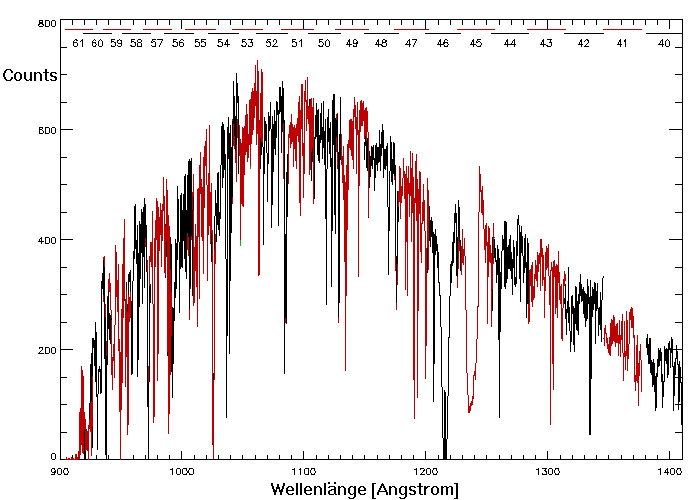
This image shows the spectrum of HD 49798 extracted from
the Echelle orders 40 to 61, which is the total wavelength range
from 900 Å to 1410 Å observable with the Echelle
spectrometer. For a better distinction the indidivual Echelle
orders are plotted in different colors. Besides two very broad
stellar absorption lines at 1216 Å (hydrogen Ly-alpha) and
1239/1243 Å
(N V, with P-Cygni profile) there are numerous extremely narrow
interstellar absorption lines visible.
![[AIT logo]](/aitlogo_x.gif)
![[Uni logo]](/unilogo_small.gif)
 deutsch
![[Valid HTML 4.0!]](/vh40.gif)