[AIT logo]

Institut für Astronomie und Astrophysik

Abteilung Astronomie

Sand 1, D-72076 Tübingen, Germany
[Uni logo]

Hinweis: Einige Seiten auf astro.uni-tuebingen.de können veraltet sein und werden nicht mehr aktualisiert.
Note: Some webpages at astro.uni-tuebingen.de may be outdated and will no longer be updated.


Stellar Atmospheres Group - Accretion Disc Modelling


Overview

 Working Groups
 Topics by keywords
 Introduction
 Theory
 Observation
 The Accretion Disc Code Package: AcDc and WOMPAT
 Publications
 Graphical Impressions
 Acknowledgment
 Further informations


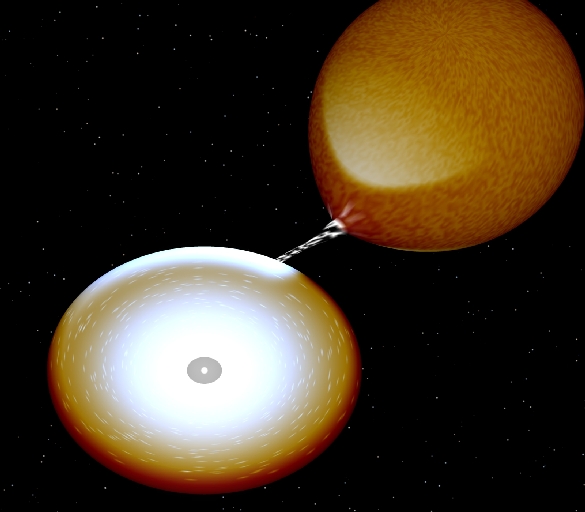
Accretion disc in a typical cataclysmic variable star.

Topics by keywords


Introduction

This is a very short description of our research interests. For more details please see the numerous articles and reviews given in our publication lists.

Accretion discs are components of objects as diverse as protoplanetary systems, active galactic nuclei, cataclysmic variables or X-ray binaries. Often, a high fraction of the luminosity of these systems is generated by the accetion disc itself. To understand these objects and interpret the observational data of increasingly high quality a realistic physical model of the accretion disc is necessary, the physical processes in the disc should be considered as accurate as possible. Our contribution to this field is the determination of accretion disc parameters like the mass accretion rate, radial extension, inclination, chemical composition, radius and mass of the central object, by means of spectroscopic analyses. This requires high quality spectra from ground and space based observatories covering the spectrum form X-rays to the infrared (see also Section Observation) as well as sophisticated computer simulations (see Section Theory) of the interaction between the radiation field with the hot plasma in the accretion disc.

We participate in several national and international cooperations.

A summary of the research activities of the institute is published at The Yearly Reports to the Astronomische Gesellschaft


Theory

Spectroscopic analyses require the comparison of accretion disc spectra with synthetic ones. Accretion disc spectra are obtained at ground or space based observatories described in the next section, the calculation of synthetic spectra are shortly described here.

Synthetic spectra are obtained from the solution of the radiation transport equations, describing the propagation of light through the vertical layers of a accretion disc. On one hand, this solution necessitates the knowledge of the physical conditions like temperature, density, mass accretion rate, viscosity and occupation numbers of the atomic levels of the plasma in order to determine its opacity and emissivity. On the other hand the radiation field interacts with the plasma and changes its physical conditions. While in stars similar to our sun, the occupation numbers of the atomic energy levels can be determined with sufficient precision from the assumption of a local thermodynamic equilibrium (LTE) this is not the case for accretion discs with an effective temperature range up to several 10000K. The level population in the non-LTE case is obtained by balancing all populating and de-populating processes from each atomic level assuming stationarity (statistical equilibrium). The complete problem is a non-linear system of integro-differential equations. Its solution requires a very efficient numerical iteration scheme, comparable to the case of stellar atmospheres.


Observation

All information about stars is obtained from the emitted light which can be detected as direct image or as spectrum.

We derive most of our results from spectroscopy. The shape of the line profiles as well as the shape of the continuum allows the derivation of the physical conditions in the accretion disc by a comparison with theoretical spectra. We obtain spectra at various ground and space based observatories like VLT (Paranal, Chile) or HST (space). The corresponding data reduction is partly done using our IDL software SPEX. Optical spectroscopy covers spectral lines of the most abundant elements, hydrogen and helium. In most cases, the important spectral lines of heavier elements like carbon, nitrogen, and oxygen reside in the UV spectral range which requires space based observations.


The Accretion Disc Codes  AcDc   and  WOMPAT

AcDc is a software package for the modelling of vertical structures and NLTE spectra of accretion discs, developed by Thorsten Nagel. It is related to the Tübingen NLTE-Model Atmosphere Package TMAP.

WOMPAT is a Monte Carlo based code for the modelling of an accretion disc wind, developed by Daniel J. Kusterer.

In the case of a geometrically thin alpha-disc, where the disc thickness is smaller than the disc diameter, the radial and vertical structure equations can be decoupled. Under the assumption of axial symmetry and by dividing the disc into concentric rings the determination of the vertical structure becomes a one-dimensional problem. The equations of radiative and hydrostatic equilibrium as well as the rate equations for the population numbers of the atomic levels are solved consistently with the radiation transfer equation under the constraint of particle number and charge conservation. Irradiation of the accretion disc by the central object can also be considered. The disc spectrum is calculated for different inclination angles, and the spectral lines are Doppler broadened according to the radial component of the Kepler rotation.

With our package, we also investigate the spectral evolution of dwarf nova outbursts.


Publications

  • In general
    • Nagel, T. 2003, Synthetische Spektren und Vertikalschichtungen von Akkretionsscheiben, Dissertation
    • Nagel, T., Dreizler, S. and Werner, K. 2002, AcDc -- A new code to calculate vertical structures and spectra of accretion disks, ASP Conf. Ser. 261: The Physics of Cataclysmic Variables and Related Objects, 509
    • Nagel, T., Dreizler, S. and Werner, K. 2002, Calculating Vertical Structures and Spectra of Accretion Disks with the New Code AcDc, ASP Conf. Ser. 288: Stellar Atmosphere Modeling, 641
    • Nagel, T., Werner, K. and Dreizler, S. 2001, AcDc - A new Code to Calculate the Vertical Structure of Accretion Disks in Astronomische Gesellschaft Meeting Abstracts, 47
  • AMCVn systems
    • Nagel, T., Dreizler, S., Rauch, T. and Werner, K. 2004, AcDc - A new code for the NLTE spectral analysis of accretion discs: application to the helium CV AMCVn, A&A, 428, 109
    • Nagel, T., Rauch, T., Dreizler, S. and Werner, K. 2004, Modeling He-rich Disks in AM CVn Binaries, RMXAA, Vol. 20. IAU Colloquium 194, 228
    • Nagel, T., Dreizler, S. and Werner, K. 2003, Calculating spectra of accretion disks in AM CVn systems, White Dwarfs, proceedings of the conference held at the Astronomical Observatory of Capodimonte, Napoli, Italy, 357
  • X-ray binaries
    • Werner, K., Nagel, T., Rauch, T., Hammer, N. J. and Dreizler, S. 2006, VLT spectroscopy and non-LTE modeling of the C/O-dominated accretion disks in two ultracompact X-ray binaries, A&A, 450, 725
    • Hammer, N. J., Kusterer, D.-J., Nagel, T., Rauch, T., Werner, K. and Dreizler, S. 2005, Modelling C/O/Ne dominated accretion discs in ultra-compact X-ray binaries, ASP Conf. Ser. 330: The Astrophysics of Cataclysmic Variables and Related Objects, 333
    • Nagel, T., Hammer, N. J., Rauch, T., Werner, K. and Dreizler, S. 2005, NLTE Spectral Analysis of Accretion Discs in Ultracompact X-ray Binaries, ASP Conf. Ser. 330: The Astrophysics of Cataclysmic Variables and Related Objects, 73
    • Werner, K., Nagel, T., Dreizler, S. and Rauch, T. 2004, Modeling of Oxygen-Neon Dominated Accretion Disks in Ultracompact X-ray Binaries: 4U 1626-67, RMXAA, Vol. 20. IAU Colloquium 194, 146
  • Dwarf Novae
    • Kromer, M., Nagel, T., and Werner, K. 2007, Synthetic NLTE accretion disc spectra for the dwarf nova SS Cygni during an outburst cycle, A&A, 475, 301
    • Kellermann, T., Nagel, T., Hammer, N. J. and Werner, K. 2005, Accretion Disc Models in Quiescence and Outburst, ASP Conf. Ser. 330: The Astrophysics of Cataclysmic Variables and Related Objects, 391
  • Symbiotic Stars
    • Nagel, T., Dreizler, S. and Werner, K. 2003, Vertical Structures and Spectra of Accretion Disks in Symbiotic Stars, ASP Conf. Ser. 303: Symbiotic Stars probing Stellar Evolution, 482
    • Werner, K., Deetjen, J.L., Dreizler, S., Nagel, T. and Rauch, T. 2003, Stellar Atmosphere and Accretion Disk Models for the Hot Component in Symbiotic Stars, ASP Conf. Ser. 303, Symbiotic Stars probing Stellar Evolution, 302
  • Supernova Fallback Disks
    • Werner, K., Nagel, T. and Rauch, T. 2007, Non-LTE modeling of supernova-fallback disks, Astrophysics and Space Science, Volume 308, Issue 1-4, pp. 141-149
    • Werner, K., Rauch, T., Suleimanov, V., and Nagel, T. 2006, Non-LTE models for neutron star atmospheres and SN fallback disks, 36th COSPAR Scientific Assembly. Held 16 - 23 July 2006, in Beijing, China., p.2213

Graphical Impressions


Acknowledgment

This research is partly granted by the Deutsche Forschungs Gemeinschaft and the Deutsches Zentrum für Luft- und Raumfahrt.


Further informations

For further informations, please contact Thorsten Nagel


[Home Page] [Working Groups] [Quick Reference] [Feedback]


Thorsten Nagel | Impressum
Last modified 24 Jan 2008
[Valid HTML 4.0!]